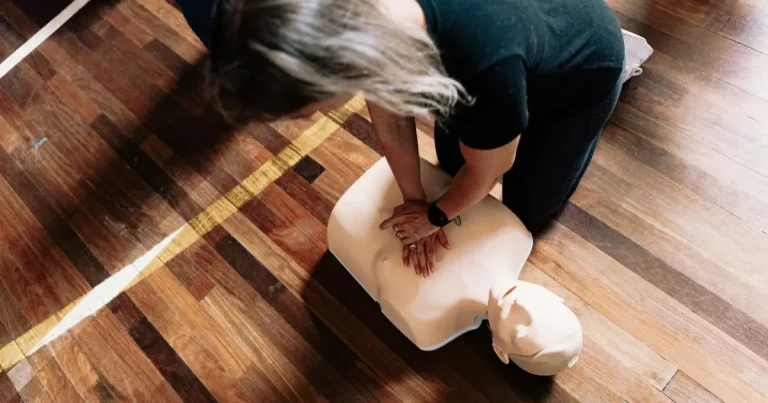

Take a hypothetical training program at a community college. It schedules 59 hours of classroom instruction over three weeks, then 16 hours of supervised practice in a skills lab and with real patients, for a total of 75 hours. At the end, a registered nurse watches each student bathe a patient, take a pulse and transfer someone from bed to chair. Pass that evaluation and you can be hired by a Medicare-certified home health agency. Fail more than one required skill and you are not done yet. Those numbers are not arbitrary. They come straight from a federal regulation, and understanding it is the fastest way to see what becoming a home health aide really takes.
The short version
- Federal rules require at least 75 hours of training for aides at Medicare-certified home health agencies, including at least 16 hours of supervised practical training.
- At least 16 hours of classroom training must come before the hands-on part.
- You must pass a competency evaluation performed by a registered nurse.
- Once working, you need at least 12 hours of in-service training every 12 months.
- Your state may add hours, a registry listing, a background check or a CNA prerequisite on top of all this.
Where the 75-hour rule comes from
The requirement sits in 42 CFR 484.80, part of the Medicare Conditions of Participation for home health agencies. It applies to aides employed by agencies that bill Medicare or Medicaid for home health services. That is why private-duty and companion care companies, which are not Medicare-certified, often hire people without this training: the rule simply does not reach them, though state home care licensing may.
The regulation lists what the training must cover. In plain terms, it includes communication skills, observing and reporting changes in a patient’s condition, reading and recording vital signs, basic infection control, body mechanics and safe transfers, personal hygiene and grooming, nutrition and fluid intake, recognizing emergencies, and respecting a patient’s rights and privacy. These are practical skills. You will spend real time practicing a bed bath on a mannequin before you ever do one in someone’s home.
The competency evaluation
Training alone does not qualify you. You also have to pass a competency evaluation, and the regulation says a registered nurse must perform it. Certain skills must be demonstrated on a real person or a “pseudo-patient” rather than described on paper. If you are rated unsatisfactory in more than one required area, you have not passed and must retrain in the areas you missed before testing again. Some states let you take a competency evaluation without a full training program if you can already demonstrate the skills, which is how some experienced family caregivers enter the field.
Staying qualified once you work
Two rules keep your status alive. First, every aide needs at least 12 hours of in-service training during each 12-month period, usually provided by the agency. Second, if you go 24 consecutive months without working as an aide for pay, your previous training no longer counts and you must complete a new program or evaluation. People who take a break for family reasons are sometimes surprised by that.
What your state may add
Federal law sets the floor. States build on it, and the details differ enough that you should look up your own state health department’s rules before paying for any course. Common additions include:
- More hours. Some states require more than 75 total hours or more clinical time.
- A CNA first. In some states the home health aide credential is an add-on to a certified nursing assistant certificate.
- A registry. Many states list trained aides on a nurse aide or home care registry that employers check before hiring.
- Background checks and health screening. Fingerprinting, a TB test or proof of certain vaccinations are common.
- Approved programs only. States typically publish a list of approved training programs. A course that is not on it may not count.
Because nursing assistant licensing overlaps with this, keep the two tracks straight. A CNA mostly works in nursing homes and hospitals. A home health aide works in patients’ homes under a nurse’s care plan. Many people hold both, but you do not need to commit to the CNA path to become an HHA in every state.
Paying for training without getting burned
Program costs vary widely, and some employers will pay. Home health agencies short on staff sometimes run their own state-approved training at no cost to new hires, occasionally asking you to stay for a set period afterward. Ask about that commitment before you sign. Workforce boards funded under the federal WIOA program can also cover training for eligible job seekers.
Be wary of online-only courses that promise an “HHA certificate” in a weekend. The federal rule requires supervised practical training with real hands-on skills, so a fully online program cannot meet it for Medicare-certified work. And no legitimate employer charges you for a job offer.
The job you are training for
Demand is strong. The U.S. Bureau of Labor Statistics projects employment of home health and personal care aides to grow 18 percent from 2025 to 2035, with about 760,500 openings a year on average, and reports a median wage of $35,800 a year ($17.21 an hour) as of May 2025, according to its Occupational Outlook Handbook. Pay depends heavily on your state and on whether the employer is Medicare-certified.
First jobs usually fall into a few buckets:
- Medicare-certified home health agencies, visiting patients recovering from surgery or managing a chronic illness.
- Hospice agencies, which also use trained aides for personal care.
- Private-duty home care companies, where the training makes you eligible for hands-on personal care assignments and sometimes a higher rate.
Your day will include travel between homes, documentation on a tablet or phone, and reporting changes to a supervising nurse. The aides who do well are the ones who notice small things, such as a new bruise, swollen ankles or an untouched lunch, and report them promptly. If you are weighing who to work for, our comparison of agency versus private caregiving lays out the trade-offs.
A simple next step
Search your state health department’s website for “home health aide training program approved” and download the official list. Pick two programs near you, then call one local home health agency and ask whether it trains new aides itself. Comparing those three options against the 75-hour, 16-hour and RN-evaluation rules above will tell you, in an afternoon, which route costs the least and gets you working soonest.